- High procedural success
-
High procedural success
When laser is used for lead extraction, over 99.5% of patients are free from SVC-related complications. Use of laser for lead extraction has low procedural mortality (0.08%) and high procedural success (96.8%). [1] - Safe lead removal
-
Safe lead removal
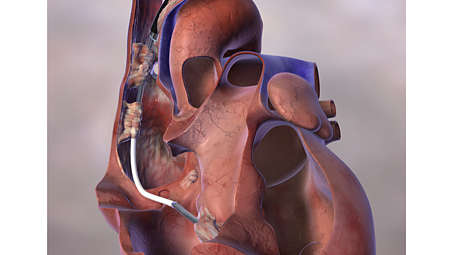
GlideLight is a contact laser sheath that uses UV light to ablate organic molecules at a penetration depth of 50 microns (about the width of a human hair).[6] It only ablates where the sheath touches tissue [2], preserving leads. - Enhanced control
-
Enhanced control
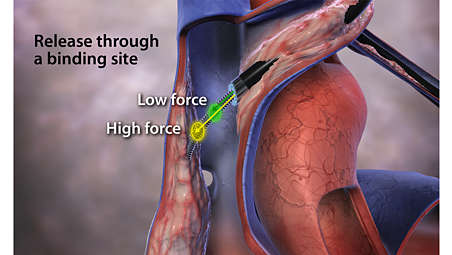
Using a high amount of mechanical force when removing leads can compromise lead integrity[7-10]. GlideLight Laser Sheath provides a high degree of control when progressing through binding sites. [3,4]. Greater control and less advancement force means less unintended forward motion. [3,4] - Procedural flexibility and efficiency
-
Procedural flexibility and efficiency
GlideLight is a highly efficient tool for use in lead extraction procedures. Its low-profile design, 15° beveled tip, and high repetition rate enable 62% more efficient advancement through tough binding sites for the same forward force. [3,4] GlideLight also offers the unprecedented ability to customize the laser’s repetition rate from 25 Hz to 80 Hz throughout a procedure, offering flexibility. [2]
High procedural success

High procedural success
High procedural success
Safe lead removal
Safe lead removal
Safe lead removal
Enhanced control
Enhanced control
Enhanced control
Procedural flexibility and efficiency

Procedural flexibility and efficiency
Procedural flexibility and efficiency
- High procedural success
- Safe lead removal
- Enhanced control
- Procedural flexibility and efficiency
- High procedural success
-
High procedural success
When laser is used for lead extraction, over 99.5% of patients are free from SVC-related complications. Use of laser for lead extraction has low procedural mortality (0.08%) and high procedural success (96.8%). [1] - Safe lead removal
-
Safe lead removal
GlideLight is a contact laser sheath that uses UV light to ablate organic molecules at a penetration depth of 50 microns (about the width of a human hair).[6] It only ablates where the sheath touches tissue [2], preserving leads. - Enhanced control
-
Enhanced control
Using a high amount of mechanical force when removing leads can compromise lead integrity[7-10]. GlideLight Laser Sheath provides a high degree of control when progressing through binding sites. [3,4]. Greater control and less advancement force means less unintended forward motion. [3,4] - Procedural flexibility and efficiency
-
Procedural flexibility and efficiency
GlideLight is a highly efficient tool for use in lead extraction procedures. Its low-profile design, 15° beveled tip, and high repetition rate enable 62% more efficient advancement through tough binding sites for the same forward force. [3,4] GlideLight also offers the unprecedented ability to customize the laser’s repetition rate from 25 Hz to 80 Hz throughout a procedure, offering flexibility. [2]
High procedural success
High procedural success
High procedural success
Safe lead removal
Safe lead removal
Safe lead removal
Enhanced control
Enhanced control
Enhanced control
Procedural flexibility and efficiency
Procedural flexibility and efficiency
Procedural flexibility and efficiency
Specifications
- GlideLight model number 500-301
-
GlideLight model number 500-301 Sheath size - 12 F
Maximum target lead diameter - 7.5 F / 0.098" / 2.50 mm
Minimum tip inner diameter - 8.3 F / 0.109" / 2.77 mm
Maximum tip outer diameter - 12.5 F / 0.164" / 4.17 mm
Working length - 50 cm
Repetition rate - 25-80 Hz
Clinical energy setting - 30-60 mJ/mm
-
- GlideLight model number 500-302
-
GlideLight model number 500-302 Sheath size - 14 F
Maximum target lead diameter - 9.5 F / 0.124"/ 3.17 mm
Minimum tip inner diameter - 10.2 F /0.134" / 3.40 mm
Maximum tip outer diameter - 14.7 F / 0.192" / 4.88 mm
Working length - 50 cm
Repetition rate - 25-80 Hz
Clinical energy setting - 30-60 mJ/mm
-
- GlideLight model number 500-303
-
GlideLight model number 500-303 Sheath size - 16 F
Maximum target lead diameter - 11.5 F / 0.150" / 3.83 mm
Minimum tip inner diameter - 12.5 F / 0.164" / 4.17 mm
Maximum tip outer diameter - 17.2 F / 0.225" / 5.72 mm
Working length - 50 cm
Repetition rate - 25-80 Hz
Clinical energy setting - 30-60 mJ/mm
-
- SLS II model number 500-001
-
SLS II model number 500-001 Max. target lead diameter - 7.5 F / 0.098" / 2.50 mm
Min. inner tip diameter - 8.3 F / 0.109" / 2.77 mm
Max. outer tip diameter - 12.5 F / 0.164" / 4.17 mm
Working length - 50 cm
Repetition rate - 20-40 Hz
Clinical energy setting - 30-60 mJ/mm
-
- GlideLight model number 500-301
-
GlideLight model number 500-301 Sheath size - 12 F
Maximum target lead diameter - 7.5 F / 0.098" / 2.50 mm
-
- GlideLight model number 500-302
-
GlideLight model number 500-302 Sheath size - 14 F
Maximum target lead diameter - 9.5 F / 0.124"/ 3.17 mm
-
- GlideLight model number 500-301
-
GlideLight model number 500-301 Sheath size - 12 F
Maximum target lead diameter - 7.5 F / 0.098" / 2.50 mm
Minimum tip inner diameter - 8.3 F / 0.109" / 2.77 mm
Maximum tip outer diameter - 12.5 F / 0.164" / 4.17 mm
Working length - 50 cm
Repetition rate - 25-80 Hz
Clinical energy setting - 30-60 mJ/mm
-
- GlideLight model number 500-302
-
GlideLight model number 500-302 Sheath size - 14 F
Maximum target lead diameter - 9.5 F / 0.124"/ 3.17 mm
Minimum tip inner diameter - 10.2 F /0.134" / 3.40 mm
Maximum tip outer diameter - 14.7 F / 0.192" / 4.88 mm
Working length - 50 cm
Repetition rate - 25-80 Hz
Clinical energy setting - 30-60 mJ/mm
-
- GlideLight model number 500-303
-
GlideLight model number 500-303 Sheath size - 16 F
Maximum target lead diameter - 11.5 F / 0.150" / 3.83 mm
Minimum tip inner diameter - 12.5 F / 0.164" / 4.17 mm
Maximum tip outer diameter - 17.2 F / 0.225" / 5.72 mm
Working length - 50 cm
Repetition rate - 25-80 Hz
Clinical energy setting - 30-60 mJ/mm
-
- SLS II model number 500-001
-
SLS II model number 500-001 Max. target lead diameter - 7.5 F / 0.098" / 2.50 mm
Min. inner tip diameter - 8.3 F / 0.109" / 2.77 mm
Max. outer tip diameter - 12.5 F / 0.164" / 4.17 mm
Working length - 50 cm
Repetition rate - 20-40 Hz
Clinical energy setting - 30-60 mJ/mm
-
Related products
Alternative products
-
TightRail
- Unparalleled control
- Flexible shaft helps you remain coaxial to the lead
- Maintains forward progression through tortuous vasculature
- Allows counter-traction at the targeted lead’s distal tip
View product
-
TightRail Sub-C
- Specifically designed for the challenges of the subclavian region
- Re-designed blade allows for efficient dilation in the subclavian region
- Shielded rotational blade minimizes risk to vessels and adjacent leads
- Use alone or with other laser or TightRail sheaths
View product


-
TightRail
With TightRail, flexibility meets unparalleled control. The tool’s flexible shaft helps physicians remain coaxial to the lead. The unique shaft technology maintains forward progression through tortuous vasculature. The dilating blade remains shielded until activated, putting physicians in control and allowing counter-traction at the targeted lead’s distal tip.
View product
-
TightRail Sub-C
TightRail Sub-C is specifically designed for the challenges of the subclavian region, including vessel entry when fibrosis and calcium are present.
View product
- 1. Christopher Aldo Rinaldi et al. Safety and success of transvenous lead extraction using excimer laser sheaths: a meta-analysis of over 1700 patients. Europace. 2023 Nov 2;25(11):euad298. doi: 10.1093/europace/euad298. PMID: 37757839; PMCID: PMC10655058
- 2. “Mechanism and Implementation of Catheter-Based Ultraviolet Photoablation” Philips Data on File, Document ref: 7030-0619
- 3. Reduced advancement force lowers the forces applied to leads during extraction, D015861-01, Data on file at Philips
- 4. A bench top study comparison (Test method D011154) of average peak push forces required to advance Laser Sheath at 40Hz vs. 80Hz (GlideLight compared to SLS II) by use of the data collected in D015786, as well as the Design Verification report D015722 Data on file at Philips
- 5. Wazni O, Epstein LM, Carrillo RG, Love C, Adler SW, Riggio DW, Karim SS, Bashir J, Greenspon AJ, DiMarco JP, Cooper JM, Onufer JR, Ellenbogen KA, Kutalek SP, Dentry-Mabry S, Ervin CM, Wilkoff BL. Lead extraction in the contemporary setting: the LExICon study: an observational retrospective study of consecutive laser lead extractions. J Am Coll Cardiol. 2010 Feb 9;55(6):579-86. doi: 10.1016/j.jacc.2009.08.070. Erratum in: J Am Coll Cardiol. 2010 Mar 9;55(10):1055. PMID: 20152562.
- 6. Philips Data on file - 7030-0619 - Mechanism and Implementation of Catheter-Based Ultraviolet Photoablation
- 7. Maytin M, Epstein, L (2011). The challenges of transvenous lead extraction. Heart, 97(5): 425-34.
- 8. Henrikson, C.A., et al. (2008). How to prevent, recognize, and manage complications of lead extraction. Part III: Procedural factors Heart Rhythm. Jul;5(7):1083-7. Epub 2007 Oct 9.
- 9. Smith MC, Love CJ. Extraction of transvenous pacing and ICD leads. Pacing Clin Electrophysiol 2008:31:736-52.
- 10. Wilkoff, B.L., et al. (1999). Pacemaker lead extraction with the laser sheath: Results of the Pacing Lead Extraction with Excimer Sheath (PLEXES) trial. JACC, 33(6), 1671-1676
- Philips medical devices should only be used by physicians and teams trained in interventional techniques, including training in the use of this device. Products subject to country availability. Please contact your local sales representative. Always read the label and follow the directions for use.
- GlideLight is distributed by LifeSystems in Australia and New Zealand.
- Potential minor adverse events associated with lead extraction procedures that may or may not require medical or surgical treatment include: a tear or damage to the blood vessels, the heart or its structures; bleeding at the surgical site; or collapsed lung. Rare but serious adverse events that require emergency medical or surgical procedures may include: a tear or damage to the blood vessels, the heart, lungs or their structures; blood clot or obstruction of the blood vessels or lungs by debris or lead fragments. Other serious complications may include: irregular heartbeat, weakened heart muscle, infection, respiratory failure or complications associated with anesthesia, stroke or death. This information is not intended to replace a discussion with your healthcare provider on the benefits and risks of this procedure to you. Caution: Federal law restricts this device to sale by or on the order of a physician.
